Most people assume black belt is the top of Brazilian jiu jitsu. It isn't. Above black belt sit the coral belts and, at the very top, the red belt. These ranks take decades of teaching and training to reach, and very few people in the world wear them.
This guide explains the highest belt in BJJ, what the red and black and red and white coral belts mean, how the black belt degrees lead up to them, and how long the journey takes under the most widely used ranking system. It also covers what academies should know when ordering belts for their instructors and students.
Short answer: the highest belt in BJJ is the red belt, which represents the 9th and 10th degrees of black belt. Below it are two coral belts: the red and black belt (7th degree) and the red and white belt (8th degree).
The Full BJJ Belt Order, From White to Red
Most academies follow the graduation system published by the International Brazilian Jiu-Jitsu Federation (IBJJF). Other federations and independent schools may differ in the details, but the overall order is widely recognized.
Adult Belts
For adults (16 and older under IBJJF rules), the belt order is:
- White
- Blue
- Purple
- Brown
- Black (1st to 6th degree)
- Red and black, the first coral belt (7th degree)
- Red and white, the second coral belt (8th degree)
- Red (9th and 10th degree)
White, blue, purple, and brown belts usually carry up to four stripes before the next promotion. On a black belt, stripes become degrees.
Kids' Belts
Children follow a separate path before joining the adult system. Under IBJJF rules, kids' belts include grey, yellow, orange, and green, each with white, solid, and black variations, from age 4 to 15. At 16, students move into the adult ranks.
What Is the Highest Belt in BJJ?
The BJJ red belt is the highest belt in jiu jitsu. The IBJJF calls it the grand master's belt, and it covers both the 9th and 10th degrees of black belt.
9th Degree Red Belt
The 9th degree is the highest rank a living practitioner can realistically work toward today. Under the IBJJF system, it requires at least 10 years at the 8th degree, which adds up to roughly 48 years of recognized activity as a black belt, plus a minimum age requirement. Only a small number of people worldwide hold it.
10th Degree Red Belt
The 10th degree is a historical honor. The IBJJF reserves it for the founding pioneers of Brazilian jiu jitsu, the small group who developed the art in Brazil in the early twentieth century. It is not a rank anyone can earn today.
So when people ask about the highest belt color in jiu jitsu, the answer is red, but the highest rank most people will ever see on a mat is a black belt with a few degrees.
What Is a Coral Belt in BJJ?
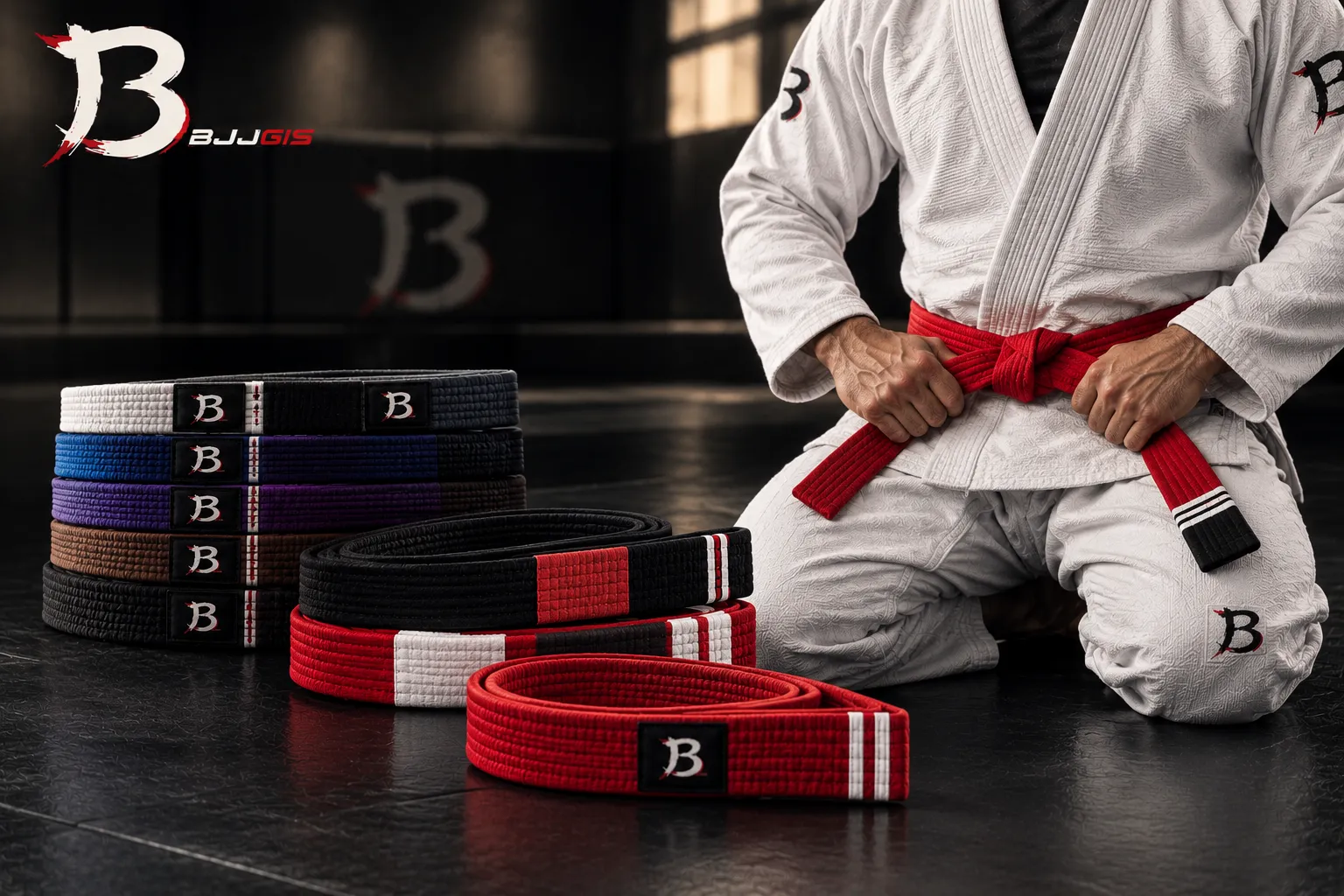
"Coral belt" is the common name for the two ranks between black and red. Both use alternating red and a second color, a pattern often compared to the bands on a coral snake. Coral belts are still black belt degrees; the belt color changes to show how long the holder has been a black belt. The IBJJF describes them as masters' belts.
Red and Black Belt (7th Degree)
The red and black belt is the first coral belt. Under the IBJJF system, it requires at least 31 years as a black belt and a minimum age. Holders have usually spent decades teaching and producing black belts of their own.
Red and White Belt (8th Degree)
The red and white belt is the second coral belt, awarded at least 7 years after the 7th degree, or around 38 years as a black belt. Fewer people hold it than the red and black belt.
Red Belt vs Coral Belt: Key Differences
| Feature | Coral belts | Red belt |
|---|---|---|
| Degrees | 7th (red and black), 8th (red and white) | 9th and 10th |
| Colors | Alternating red and black, or red and white | Solid red |
| Approximate years as a black belt (IBJJF minimum) | 31 for 7th, 38 for 8th | About 48 for 9th; 10th reserved for pioneers |
| Common title | Master | Grand master |
| How rare | Very rare | Extremely rare |
Black Belt Degrees: The Timeline to Coral and Red
Getting a black belt typically takes many years of consistent training. Once you are a black belt, a new clock starts. Under the IBJJF graduation system, each degree has a minimum waiting period:
| Degree | Minimum wait from previous degree | Total years as a black belt |
|---|---|---|
| 1st | 3 years | 3 |
| 2nd | 3 years | 6 |
| 3rd | 3 years | 9 |
| 4th | 5 years | 14 |
| 5th | 5 years | 19 |
| 6th | 5 years | 24 |
| 7th (red and black) | 7 years | 31 |
| 8th (red and white) | 7 years | 38 |
| 9th (red) | 10 years | 48 |
Minimum Ages
The IBJJF also sets minimum ages for adult belts and for the coral and red belts. These are published in its graduation system and can be updated, so check the current version for exact figures.
Minimums Aren't Typical Timelines
These numbers are floors, not schedules. Promotions depend on the instructor and, for degrees, on continued activity such as teaching, training, competing, or refereeing. Many practitioners take longer than the minimum at every stage.
How Are Coral and Red Belts Awarded?
Coral and red belts can't be won in competition or earned through a test. They recognize a lifetime of contribution: years of teaching, producing black belts, and helping the art grow. Promotions at this level are usually given by a senior instructor in the practitioner's lineage and, where applicable, registered with a federation.
That is why lineage matters. A legitimate rank can be traced from instructor to instructor. If a school promises unusually fast promotions, ask about the instructor's lineage and federation registration.
Share your colors, sizes and branding — we will prepare a sample for your academy.
Request a quote →Common Myths About the BJJ Highest Belt
- "Black belt is the highest rank." Black belt is the start of the degree system. Coral and red belts sit above it.
- "Anyone can work toward 10th degree." The 10th degree is reserved for the art's founding pioneers. The highest Brazilian jiu jitsu belt open to practitioners today is the 9th degree red belt.
- "Coral belts are honorary titles, not ranks." A coral belt in jiu jitsu is a real rank: it is the 7th or 8th degree of black belt, with minimum time requirements.
- "You can earn coral or red belts through competition." These ranks recognize decades of teaching and contribution, not tournament results.
- "Every martial art uses the same colors." Judo, karate, and Japanese jujitsu have their own systems; red belts and coral belts there can mean different things.
Do All Academies Follow the Same System?
Not exactly. The IBJJF system is the most widely recognized, especially for competition, but other federations and independent academies may use different time requirements, stripe systems, or kids' belt structures. Some no-gi programs use ranked rash guards instead of belts. If you are unsure how your academy handles promotions, ask your instructor.
Why the Ranks Above Black Belt Matter
For a white belt, coral and red belts can feel irrelevant. But they show how BJJ values time on the mat. The system rewards people who keep training and teaching for decades, which is one reason a legitimate black belt carries so much respect. They also remind students that black belt isn't the finish line; it is the start of a much longer path.
For Academies: Ordering Belts for Every Rank
Academies need belts for every stage: kids' colors, adult ranks, and sometimes coral or red belts for senior instructors.
What Academies Need From a Belt Supplier
Accurate, Consistent Colors
Belt colors should match across sizes and reorders. A blue belt that looks different from the last batch is noticeable when students line up by rank.
Rank Bars and Degree Markings
Most adult belts have a rank bar for stripes. Higher degrees and coral belts follow specific conventions for bars and markings, so share your federation's or academy's requirements with your supplier.
Keep Approved Samples
Keep an approved sample of each color and size so future batches can be checked against it.
Ordering Through BJJ Gis
BJJ Gis manufactures ranked belts and custom BJJ belts in Sialkot, Pakistan, for academies and brands in the United States and worldwide. Academies can add logos or names with embroidery, outfit coaches with instructor uniforms, and supply students' belts alongside their gis through an academy uniform program. For younger students, belts can be coordinated with kids' gis. If you need coral or red belts for a senior instructor, ask about custom belt colors when you request a quote.
Final Thoughts
The highest belt in BJJ is the red belt, worn by grand masters at the 9th degree and historically by the art's founders at the 10th. Below it, the red and black and red and white coral belts recognize more than three decades as a black belt. These ranks take a lifetime, and they show why every belt in Brazilian jiu jitsu is earned slowly and respected.
For academies, belts are part of that culture. Choose belts with consistent colors and sizes, and keep approved samples so every promotion looks right.
Need ranked belts for your academy? Request a quote from BJJ Gis with your colors, sizes, and branding, or message our team on WhatsApp to discuss samples.