A belt that is too short barely ties and comes loose every round. A belt that is too long leaves tails flapping around your knees. Most people assume their belt size simply matches their gi size, and often it does, but belt lengths vary more between brands than most buyers expect.
This BJJ belt size guide explains how BJJ belt sizes work, why one brand's A2 can be noticeably longer than another's, how to work out the length you actually need, and what academies should check when ordering belts for a full roster.
Short answer: start with the same size as your gi, then check the brand's own BJJ belt size chart for the actual length. If you are between sizes or have a thick waist, choose the longer belt.
How BJJ Belt Sizes Work
Most brands label belts with the same letter-and-number system used for gis:
- A sizes (adult), commonly A0 to A5 or A6
- F sizes (women's), offered by some brands
- M or C sizes (kids), depending on the brand
Each size corresponds to a total belt length, usually listed in centimeters or inches. The catch is that these sizes are not standardized. Every brand sets its own lengths, so the size label only tells you roughly where to start.
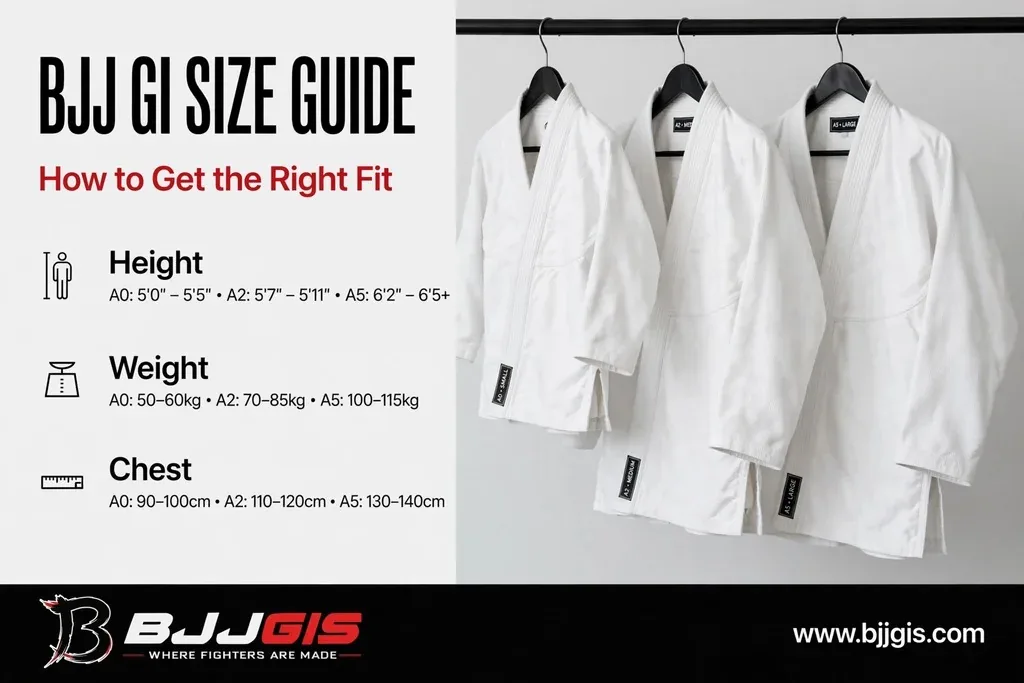
If you aren't sure of your gi size yet, our BJJ gi size guide explains how A-sizing works for gis.
BJJ Belt Size Chart: Why Lengths Differ Between Brands
Treat any jiu jitsu belt size chart, including the one below, as brand-specific. To show how much sizing varies, here are the adult belt lengths published by three different brands. These are their listed lengths, not a universal standard, and they may have changed since publication.
| Size | Brand A | Brand B | Brand C |
|---|---|---|---|
| A0 | 255 cm (100 in) | 238 cm (94 in) | 257 cm (101 in) |
| A1 | 275 cm (108 in) | 254 cm (100 in) | 264 cm (104 in) |
| A2 | 295 cm (116 in) | 274 cm (108 in) | 279 cm (110 in) |
| A3 | 310 cm (122 in) | 292 cm (115 in) | 297 cm (117 in) |
| A4 | 325 cm (128 in) | 308 cm (121 in) | 307 cm (121 in) |
| A5 | 340 cm (134 in) | 335 cm (132 in) | 351 cm (138 in) |
What the Comparison Shows
At A2, the difference between the shortest and longest belt in this table is about 21 cm (8 in). That is enough to change how long your tails hang or whether a thick knot ties comfortably. Two practical lessons follow:
- Always check the length on the specific brand's chart rather than relying on the size label.
- If you liked the length of a previous belt, measure it and look for a new belt with a similar listed length.
What Size BJJ Belt Do I Need?
Start With Your Gi Size
For most adults, the belt size that matches their gi size is a reasonable starting point. A belt that comes with a gi is usually sized to go with it. This works best for people with an average build for their height.
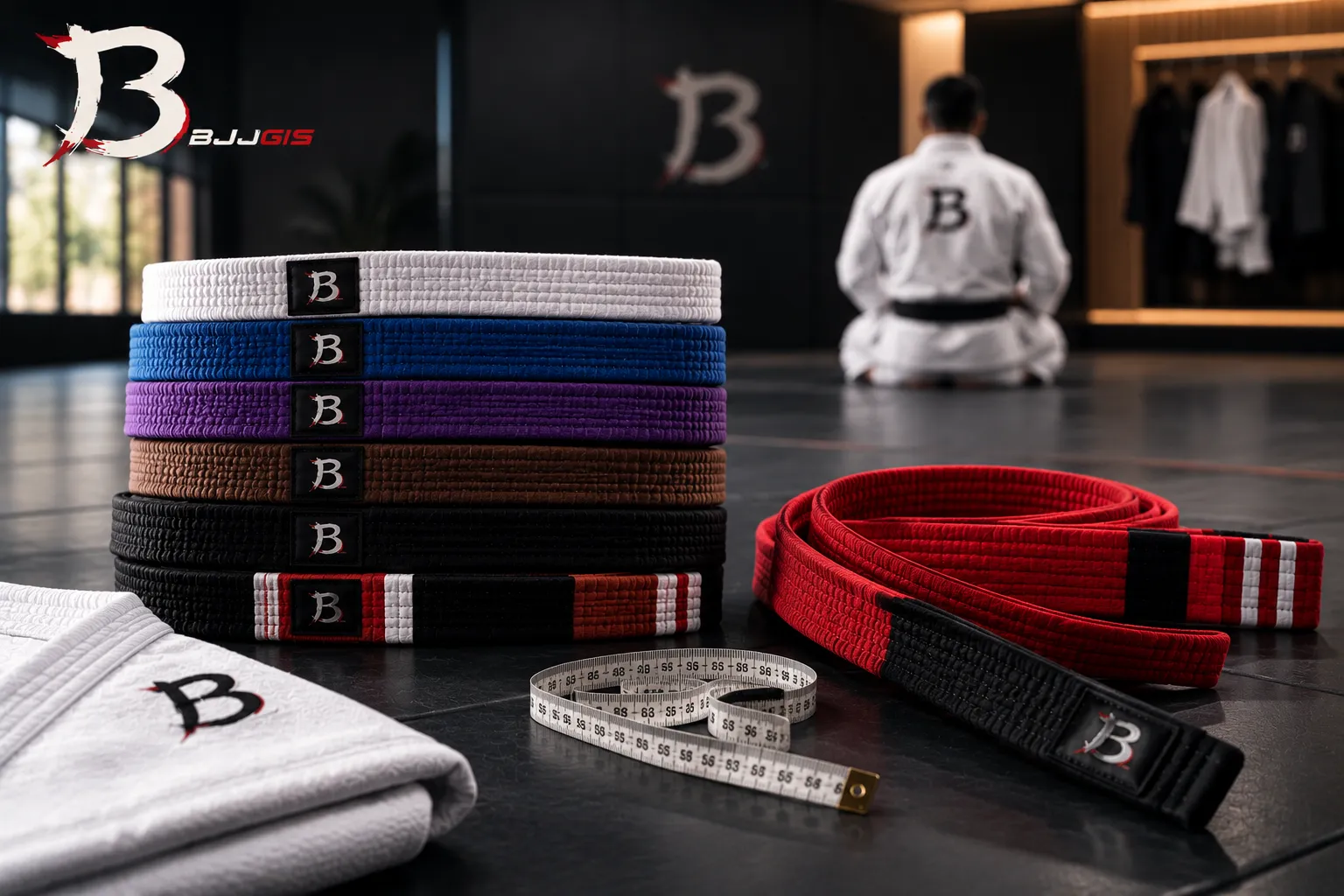
Measure With a Cord or Old Belt
The most reliable way to find your ideal BJJ belt length is to measure it directly:
- Put on your gi jacket and close it.
- Take a long piece of cord, rope, or an old belt.
- Wrap it around your waist twice, as you would a belt, and tie the standard belt knot.
- Leave tails as long as you want your belt ends to hang.
- Untie it and measure the full length used, from end to end.
That measurement is your target belt length. Compare it with the brand's chart and choose the size closest to it, rounding up if you are between sizes. If you need help with the knot itself, follow the steps for the standard BJJ belt knot your academy teaches.
Compare With the Brand's Chart
Some brands list waist ranges alongside belt lengths, while others list only total length or height and weight. A waist-based chart is usually the most useful, since belt fit depends on your waist over the gi more than your height.
If You Are Between Sizes
Choose the longer belt. A belt that is slightly long can still be tied neatly, and tails can sit a little lower. A belt that is too short can't be fixed.
How Long Should a BJJ Belt Be When Tied?
The right jiu jitsu belt length leaves enough to tie a secure knot with tails to spare. Once tied, both tails should hang roughly evenly and be long enough to grip and tighten the knot. For most people, that means the ends reach somewhere around the upper thigh.
Competition rules may set specific limits. The IBJJF, for example, has rules on belt width and how long the ends should hang after the knot is tied; these are commonly cited as 4 to 5 cm wide with ends of 20 to 30 cm, but check the current rulebook before an event, since rules can change. Other federations may use different standards.
Factors That Change the Belt Length You Need
Waist and Build
A belt wraps your waist twice, so your waist measurement matters more than your height. Two people who wear the same gi size can need different belt lengths if one has a broader midsection.
Gi Thickness
A heavy gi jacket adds bulk under the belt. If you train in a thicker gi, allow for a little extra length.
Belt Thickness and Stiffness
Thicker, stiffer belts create a larger knot and use more length to tie. A new, stiff belt may also feel shorter until it softens with use.
Knot Style
Most methods wrap the belt twice, but some knot variations use slightly more or less length. If you use a specific method, measure while tying it that way.
Shrinkage
Cotton belts can shrink a little when washed in hot water or tumble dried. Washing in cold water and hanging the belt to dry helps limit that, using the same habits as our guide on how to wash a BJJ gi. If a brand notes expected shrinkage, factor it in when choosing between sizes.
Share your sizes, colors and branding — we will prepare a sample and confirm lengths.
Request a quote →Kids' and Women's BJJ Belt Sizes
Kids' belts use separate sizing, often labeled M or C, and should match the child's gi and waist rather than their age. A belt that is too long can trail on the mat, while a short one won't stay tied. Coordinating belts with kids' gis makes sizing easier for parents and academies.
Some brands offer women's sizing, often labeled F. Where they don't, women usually choose an A size based on waist measurement. Coordinating belts with women's gis from the same supplier helps keep sizing consistent.
Jiu Jitsu Belt Size Guide: Quick Checklist
Use this checklist before buying a new belt:
| Step | What to do |
|---|---|
| 1 | Note your gi size as a starting point |
| 2 | Measure your ideal length with a cord over your gi |
| 3 | Find the brand's chart and compare listed lengths, not just size labels |
| 4 | Account for a thick gi, a stiff belt, or a broader waist |
| 5 | Round up if you are between sizes |
| 6 | If you compete, check current belt rules |
| 7 | Wash cold and hang dry to limit shrinkage |
If you follow these steps, choosing the right jiu jitsu belt size takes only a few minutes.
Signs Your Belt Is the Wrong Size
Too short:
- You struggle to complete the knot or it comes loose quickly.
- The tails are very short or uneven no matter how you center it.
Too long:
- The tails hang down near the knee.
- Excess belt gets in the way during guard work.
- You are tempted to wrap it a third time.
For Academies: Ordering Belts in the Right Sizes
For academies, belt sizing affects promotions, retail sales, and how students look when they line up.
Build a Size Run That Matches Your Students
Look at your student roster and gi sizes before ordering. Most academies need a range of kids' sizes and adult sizes, with more units in the middle sizes.
Grade Lengths Consistently
Ask your supplier for the exact length of each belt size and confirm that the jumps between sizes are even.
Test the Extremes
Order samples in the smallest and largest sizes as well as a middle size. Tie each one on someone who wears that size and check the tail length.
Publish a Chart for Students
Once sizes are approved, publish a simple size chart with lengths for your students and parents. It reduces wrong-size orders and exchanges.
Ordering Belts From BJJ Gis
BJJ Gis manufactures BJJ belts and ranked belts in Sialkot, Pakistan, for academies and brands in the United States and worldwide. Ask for the belt length chart with your quote so you can match it to your students. Belts can be supplied alongside uniforms through an academy uniform program, with size labels and packaging handled through custom labels and packaging.
Final Thoughts
The best way to choose a BJJ belt size is to start with your gi size, then check the actual length on the brand's chart. Because sizes aren't standardized, a quick cord measurement taken over your gi is the most reliable way to find the length you need. When in doubt, choose the longer belt.
For academies, confirm exact lengths for every size, test the smallest and largest sizes, and publish a simple chart for students.
Ordering belts for your academy or brand? Request a quote from BJJ Gis with your sizes, colors, and branding, or message our team on WhatsApp to discuss samples and belt lengths.