Almost every new student has the same experience: the belt looks fine at the start of class, then two rounds later it is hanging loose and the gi jacket is wide open. Learning to tie a BJJ belt properly takes a few minutes of practice and saves a lot of retying on the mat.
This guide explains how to tie a Brazilian jiu jitsu belt step by step using the standard knot, plus two alternative methods, how to check that your knot is correct, why belts come undone, and what academies should look for in belts that hold a knot.
Before You Start: Check Your Belt Length
A belt that is too short is the most common reason a knot won't hold. Once tied, both ends should hang down with enough length to grip and pull the knot tight, usually reaching the upper thigh. If you can barely complete the knot, the belt is too short.
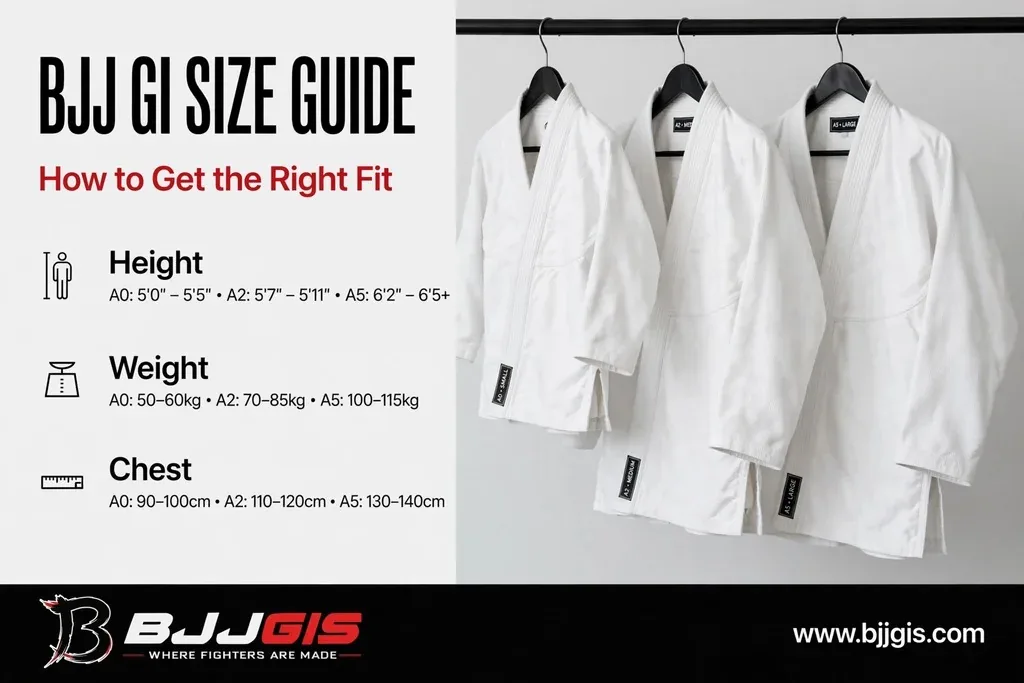
Belt sizes usually follow the same A-sizing as adult gis (or M-sizes for kids), but sizes aren't standardized between brands. Check the brand's size chart and, if you are between sizes, choosing the longer belt is generally safer. Our BJJ gi size guide explains how A-sizing works.
Put your gi jacket on first, left lapel over right, and keep it closed while you tie the belt over it.
How to Tie a BJJ Belt: The Standard Knot
This is the method most academies teach when showing new students how to tie a gi belt. The belt wraps around your waist twice and finishes with a flat square knot.
Step-by-Step Instructions
- Find the center. Fold the belt in half and hold the midpoint.
- Place the center on your stomach. Hold the midpoint against your stomach, around or just below the navel, with equal lengths hanging on each side.
- Wrap the ends around your back. Take both ends behind you, cross them, and bring them back to the front. The belt now circles your waist twice. Keep the layers flat and snug.
- Tuck one end under both layers. Cross one end over the other at the front. Then take the end on top and tuck it up underneath both layers of belt across your stomach, from bottom to top. Pull it through so it points up.
- Form the knot. Cross the upward end over the hanging end to form an X, then bring it under and through the loop that forms just below the belt.
- Tighten. Pull both ends firmly outward to the sides, not straight up and down. The knot should sit flat with the ends hanging evenly to the left and right.
That's the standard BJJ belt knot, and it is the same jiu jitsu belt knot whatever your rank.
Check Your Knot
A correct knot sits flat against the belt, with both tails coming out sideways and hanging at roughly the same length. If the ends are uneven, you didn't start from the true center; untie it and adjust before tying again.
If the Ends Point Up and Down
If one tail points up and the other points down, you have tied a granny knot instead of a square knot. It looks crooked and tends to slip. Untie the final knot and cross the ends the opposite way in step 5.
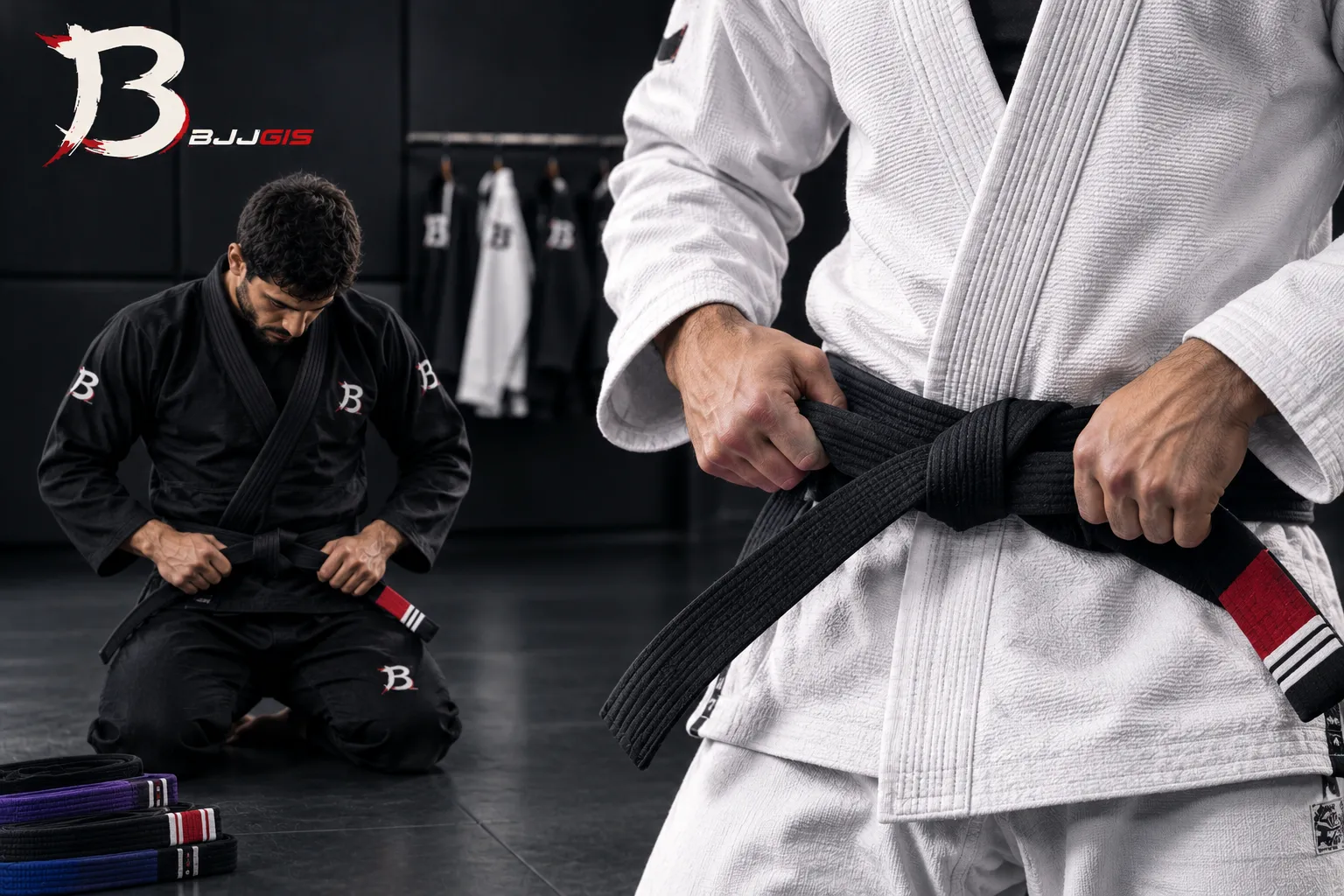
Other Ways to Tie a BJJ Belt
Different academies and instructors teach a few variations. These are the two you are most likely to see.
Flat-Wrap Knot
Some people don't like the belt layers crossing behind their back. The flat-wrap method keeps both layers parallel all the way around. Names vary between academies; it is sometimes called the pro knot or Hollywood knot.
- Hold one end against your stomach near the center, leaving a tail about as long as you want the finished ends to hang.
- Wrap the long end around your waist twice, keeping it flat and covering the short end.
- Bring the long end to the front and tuck it up underneath both layers.
- Tie the two ends together in a square knot, as in steps 5 and 6 above, and pull outward to tighten.
Check that both tails end up roughly even. If not, adjust the starting tail length and try again.
Single-Wrap Method
The single wrap circles the waist once before knotting. It can be useful for a belt that is too short to wrap twice or for very young kids, but it is less secure than the standard double wrap. Most instructors recommend the standard knot once your belt is long enough.
BJJ Belt Tying Quick Reference
Once you know how to tie a jiu jitsu belt one way, the others are easy to learn. Here is how the three methods compare:
| Method | Wraps | Back of belt | Security | Best for |
|---|---|---|---|---|
| Standard knot | Two | Layers cross | High | Everyday training and competition |
| Flat-wrap knot | Two | Layers flat | High | People who want a neat back |
| Single wrap | One | Single layer | Lower | Short belts, very young kids |
Why Your BJJ Belt Keeps Coming Undone
If your belt won't stay tied, work through these causes:
- The belt is too short. Short tails mean a small, weak knot. A longer belt usually fixes the problem.
- The wraps were loose before knotting. Snug the layers around your waist before tucking and tying.
- It's a granny knot. Ends pointing up and down slip more easily than a flat square knot.
- You tightened upward. Pulling the tails out to the sides flattens the knot; pulling up twists it.
- The belt is very soft or worn. Older belts can become slippery and hold knots less well. A new belt may feel stiff at first but often holds better.
Share your colors, sizes and branding — we will prepare a sample for your academy.
Request a quote →Tying Your Belt for Competition
In competition, a belt that comes undone stops the action and has to be retied, which breaks your rhythm. Most competitors use the standard knot and pull it as tight as they comfortably can before stepping on the mat.
Federations such as the IBJJF have rules on how the belt is worn, its width, and how long the ends should hang, along with how quickly you must retie it if it comes loose. Those rules change, so check the current rulebook for your event and practice tying your belt quickly under pressure.
Helping Kids Tie Their Belts
Young children usually need help tying their belts, and that's normal. Parents and coaches can teach the standard knot slowly, one step at a time, and practice at home. A kids' belt that matches the size of their kids' gi makes the process easier; a belt that is too long can trip children up, while one that is too short won't stay tied.
Belt Etiquette and Care
Belt customs vary by academy. Some schools expect students to tie their belts before lining up and to retie quietly at the edge of the mat. Many belts have a rank bar with stripes on one end; where it sits when tied depends on academy convention, so follow your instructor.
The old idea that you should never wash your belt is mostly folklore. Belts collect the same sweat as the rest of the uniform. Wash them in cold water and hang dry, using the same approach as our guide on how to wash a BJJ gi.
For Academies: Choosing Belts That Stay Tied
Students blame themselves when their belt keeps loosening, but belt construction plays a part too.
What Makes a Belt Hold a Knot
Core, Stiffness, and Stitching
A belt with a firm core and multiple rows of stitching along its length tends to keep its shape and hold a knot better than a thin, soft belt. Width, thickness, and fabric finish all affect how the knot sits and how much it slips.
Test Samples Before Ordering
Tie a sample belt using the standard knot, train in it through drilling and live rounds, and check how often it loosens. Wash it a few times and test again.
Check Sizes Across the Range
Test the smallest and largest sizes you plan to order, not just the middle size. A belt that works in A2 may run short in A4 if sizing isn't graded correctly.
Ordering Belts for Your Academy
Academies usually need ranked belts in every color and size, with rank bars that accept stripes cleanly. Some add academy logos or names through embroidery. BJJ Gismanufactures BJJ belts in Sialkot, Pakistan, for academies and brands in the United States and worldwide, and belts can be supplied alongside uniforms through an academy uniform program.
Final Thoughts
Tying a BJJ belt properly comes down to a few habits: start from the true center, keep the wraps snug and flat, tuck one end under both layers, finish with a flat square knot, and tighten by pulling outward. If your belt still won't stay tied, check its length and condition before blaming your technique.
For academies, belts that hold a knot well save class time and frustration. Test samples, check sizing across your range, and order belts that match your students' gis.
Need ranked belts or custom academy belts? Request a quote from BJJ Gis with your colors, sizes, and branding, or message our team on WhatsApp to discuss samples.